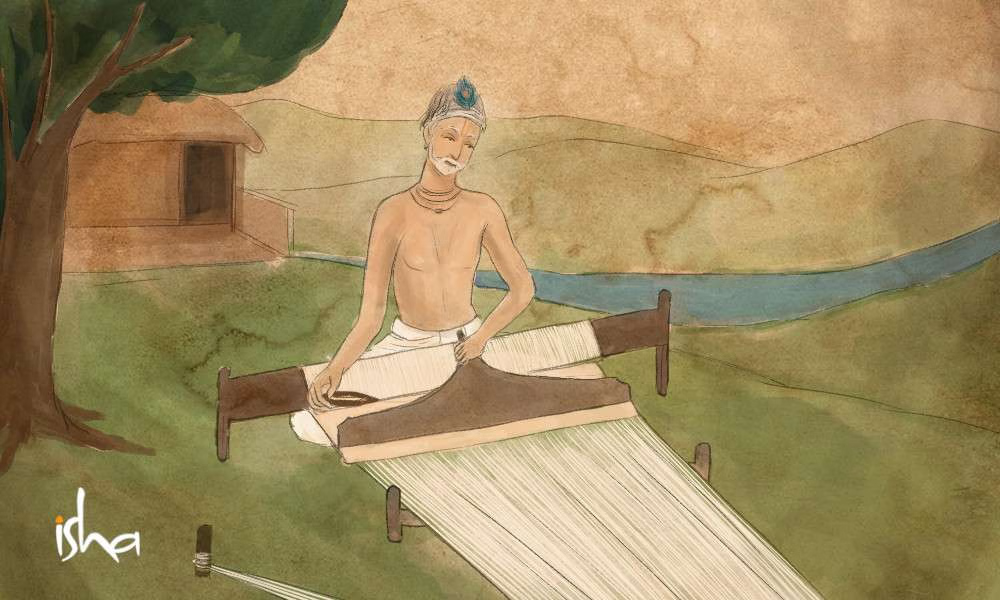
The Intoxication of Love: A Journey Beyond Words
In the profound words of Kabir, "Where is the need of words, when love has made drunken the heart?" This evocative statement invites us to reflect on the limitations of language in expressing the depths of our emotional and spiritual experiences. Kabir, a 15th-century poet-saint, suggests that when one is truly immersed in love—whether divine or human—the heart becomes so full that it transcends the need for verbal expression. This notion is particularly significant in a world often dominated by the need to articulate feelings, where silence can be a more powerful testament to love than any spoken word.
As we delve deeper into this quote, we uncover layers of meaning that resonate with the essence of bhakti, the devotional path that Kabir exemplified. Love, in this context, is not merely an emotion but a transformative force that alters our perception of reality. It intoxicates the heart, leading to a state of blissful surrender where the self dissolves into the beloved. This state of being invites us to consider how often we rely on words to convey our feelings, and whether true understanding might lie in the silence that follows love's intoxication.
The image / the metaphor
The imagery in Kabir's quote is rich and evocative, conjuring the sensation of being 'drunken' with love. The choice of the word "drunken" suggests a state of ecstasy, where the heart is overwhelmed and perhaps even disoriented by the intensity of feeling. This intoxication implies a loss of control, a surrender to something greater than oneself. In this state, the heart is so full that it spills over, rendering words unnecessary. The metaphor of drunkenness also evokes a sense of liberation, as if love frees us from the constraints of rational thought and societal expectations.
Diving deeper into this metaphor, we see that love's intoxication can lead to profound insights and experiences that are often ineffable. Just as a person who is intoxicated may struggle to articulate their thoughts clearly, so too does the lover find that the essence of their experience transcends language. In this way, Kabir invites us to embrace the paradox of love: that it can both elevate us to sublime heights and leave us speechless. This duality reflects the complexity of human emotion and the spiritual journey, where the heart's deepest truths often reside beyond the reach of words.
In the speaker's tradition
Kabir's teachings are deeply rooted in the bhakti tradition, which emphasizes a personal, loving relationship with the divine. This path encourages practitioners to cultivate devotion (bhakti) as a means of realizing their connection to the ultimate reality. Concepts such as dharma, or righteous living, and kenosis, the self-emptying love, resonate with Kabir's assertion that love can lead us to a state where the self is transcended. In this light, the intoxication of love becomes a spiritual practice, a way to dissolve the ego and experience unity with the beloved, whether that be God or another person.
In the context of bhakti literature, Kabir's sentiments echo the teachings found in the works of other saints, such as Mirabai and Tulsidas, who also emphasize the power of love to transform the heart. For instance, in the poetry of Mirabai, we find a similar theme of surrendering to love, where the lover becomes one with the divine. This shared understanding across the bhakti tradition highlights the universality of Kabir's message: that love, in its purest form, transcends the need for words and invites us into a deeper communion with the divine.
Living the teaching
Consider a modern scenario where this teaching might resonate: a moment of deep connection with a loved one, perhaps during a shared silence after a heartfelt conversation. In such instances, words may seem inadequate to capture the depth of emotion felt between two people. This silence, filled with unspoken understanding and mutual affection, embodies the essence of Kabir's quote. It serves as a reminder that sometimes the most profound expressions of love occur not through words, but through presence and shared experience.
Another application of this teaching can be found in moments of conflict or misunderstanding within relationships. When tensions rise, the urge to articulate grievances can often lead to further discord. However, if we pause and allow ourselves to feel the love that underlies our connections, we may find that silence can be a powerful tool for healing. By stepping back from the need to explain or defend, we create space for love to re-emerge, reminding us that the heart's truth often speaks louder than words ever could.
A reflection
As we contemplate Kabir's profound assertion, we are invited to consider the role of silence in our own lives. How often do we find ourselves caught in the cycle of needing to articulate our feelings, rather than simply allowing ourselves to feel them? In moments of love, joy, or even sorrow, can we embrace the silence that follows, trusting that it carries its own weight of meaning? Reflecting on this question may lead us to a deeper understanding of our relationships and the transformative power of love.




Join the BrightStar Community
Stay connected with daily inspiration, event announcements, and community wisdom