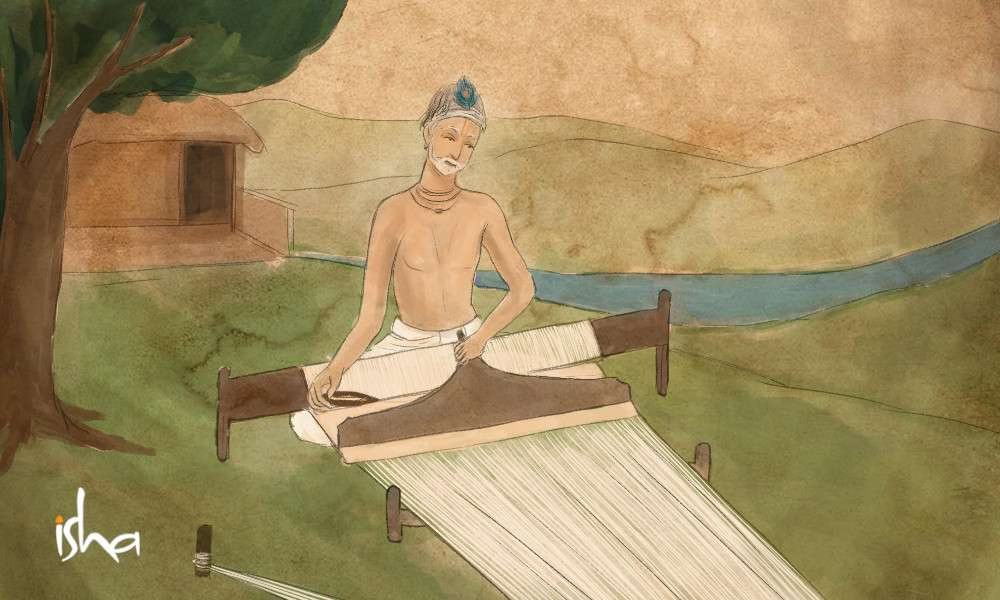
The Divine Dance of Love: Understanding Kabir's Vision
In the profound words of Kabir, "He himself is the lover, He is the love, He is the beloved," we are invited into a sacred exploration of love's essence. This statement encapsulates a mystical understanding of unity, suggesting that the divine presence permeates every aspect of love. It challenges us to reconsider our perceptions of separation and individuality, urging us to recognize that the lover, the act of loving, and the beloved are not distinct entities but rather manifestations of a singular divine reality. This realization holds significant implications for our spiritual journeys, as it invites us to dissolve the boundaries that often isolate us from one another and from the divine.
As we delve deeper into this quote, we uncover layers of meaning that resonate with the heart of the bhakti tradition. Kabir, a poet-saint of the 15th century, speaks from a place of deep devotion and insight, revealing that love is not merely an emotion or a fleeting experience but a profound state of being. By asserting that the lover, love, and beloved are one, Kabir invites us to experience love as an all-encompassing force that transcends duality. This perspective encourages us to cultivate a sense of oneness with all beings, fostering compassion and understanding in our interactions with the world.
The image / the metaphor
The imagery in Kabir's quote is rich and evocative, painting a picture of an intimate relationship that defies conventional boundaries. The use of the terms "lover," "love," and "beloved" suggests a dynamic interplay, where each role is essential to the experience of love itself. This triadic relationship evokes a sense of wholeness, where the act of loving is inseparable from the essence of love and the presence of the beloved. The verbs chosen—"is"—indicate a state of being rather than a mere action, emphasizing the eternal and unchanging nature of this divine love.
Diving deeper into the metaphor, we can see that Kabir's words reflect the interconnectedness of all existence. The lover's passion, the love's warmth, and the beloved's receptivity create a harmonious cycle that mirrors the cosmic dance of creation. This metaphor serves as a reminder that love is not a possession or a transaction but a sacred flow that binds us to one another and to the divine. In this light, love becomes a transformative force, capable of transcending the limitations of the ego and revealing the underlying unity of all beings.
In the speaker's tradition
To fully appreciate Kabir's insights, we must situate them within the broader context of the bhakti tradition, which emphasizes personal devotion and the intimate relationship between the individual and the divine. Concepts such as dharma, or righteous living, and bhakti, the path of devotion, are central to this tradition. Kabir's assertion of unity in love resonates with the idea of "fana," or annihilation of the self in the divine presence, where the individual ego dissolves into the greater whole. This understanding invites practitioners to cultivate a deep sense of surrender and devotion, recognizing that true love emerges from the relinquishing of the self.
Moreover, Kabir's teachings can be compared to those found in other spiritual texts, such as the "Bhagavad Gita," where the nature of love and devotion is explored through the lens of selfless action and surrender to the divine will. In the Gita, Krishna speaks of the importance of seeing the divine in all beings, echoing Kabir's call to recognize the interconnectedness of love. This shared wisdom across traditions highlights the universal nature of Kabir's message, inviting seekers to engage with love as a transformative force that transcends individual differences.
Living the teaching
In our modern lives, the teaching encapsulated in Kabir's quote can find expression in various scenarios. Consider a moment of conflict in a personal relationship, where misunderstandings and hurt feelings create a sense of separation. By embodying the understanding that "He himself is the lover, He is the love, He is the beloved," we can approach the situation with compassion and empathy. This perspective encourages us to see beyond our grievances and recognize the shared humanity that binds us, allowing love to flow freely and heal the rift.
Another application of this teaching can be found in daily practices of mindfulness and self-reflection. When we engage in meditation or contemplative prayer, we can focus on the essence of love as a unifying force within ourselves. By recognizing that the divine presence resides within us as both the lover and the beloved, we cultivate a deeper sense of connection to ourselves and to others. This practice not only nurtures our spiritual growth but also empowers us to embody love in our interactions, transforming the mundane into the sacred.
A reflection
As we contemplate Kabir's profound assertion, we are left with a contemplative question that invites introspection: How can I embody the understanding that love is a unifying force in my life? This question encourages us to reflect on our relationships, our actions, and our perceptions of self and other. By embracing the idea that we are all interconnected through love, we can begin to dissolve the barriers that separate us and cultivate a more compassionate and harmonious existence.




Join the BrightStar Community
Stay connected with daily inspiration, event announcements, and community wisdom